

Three cheers and four grumbles: some thoughts about picture books
A Story Street Special

This is the first in a new, occasional series of newsletters from author/illustrator Jane Porter, exploring a single topic. If you’re here for the usual snippets about random things I’ve been up to, don’t worry, normal service will be resumed on 1st July in my next newsletter.
I’ve tried to put into words some thoughts I’ve been having lately about picture books - specifically, the rapidly changing business of picture books. If you are interested in stories as a reader, or you are (or would like to be) a picture book maker, I’d love to know what you think. Do join in with some comments if something resonates. Let’s get a discussion going…
Oh, and if you’d like to know more about the process behind producing picture books, I interviewed a series of brilliant creatives on YouTube a while back and the videos are still worth a watch.
A bit of background
I’ve been very lucky to have changed career in my 40s (previously I was a writer and editor on magazines about landscape and horticulture). I’ve had a decent number of picture books published, as author or illustrator or both, with some major publishers. I’ve worked with some lovely people, and learned a lot. I’ve lived the dream!
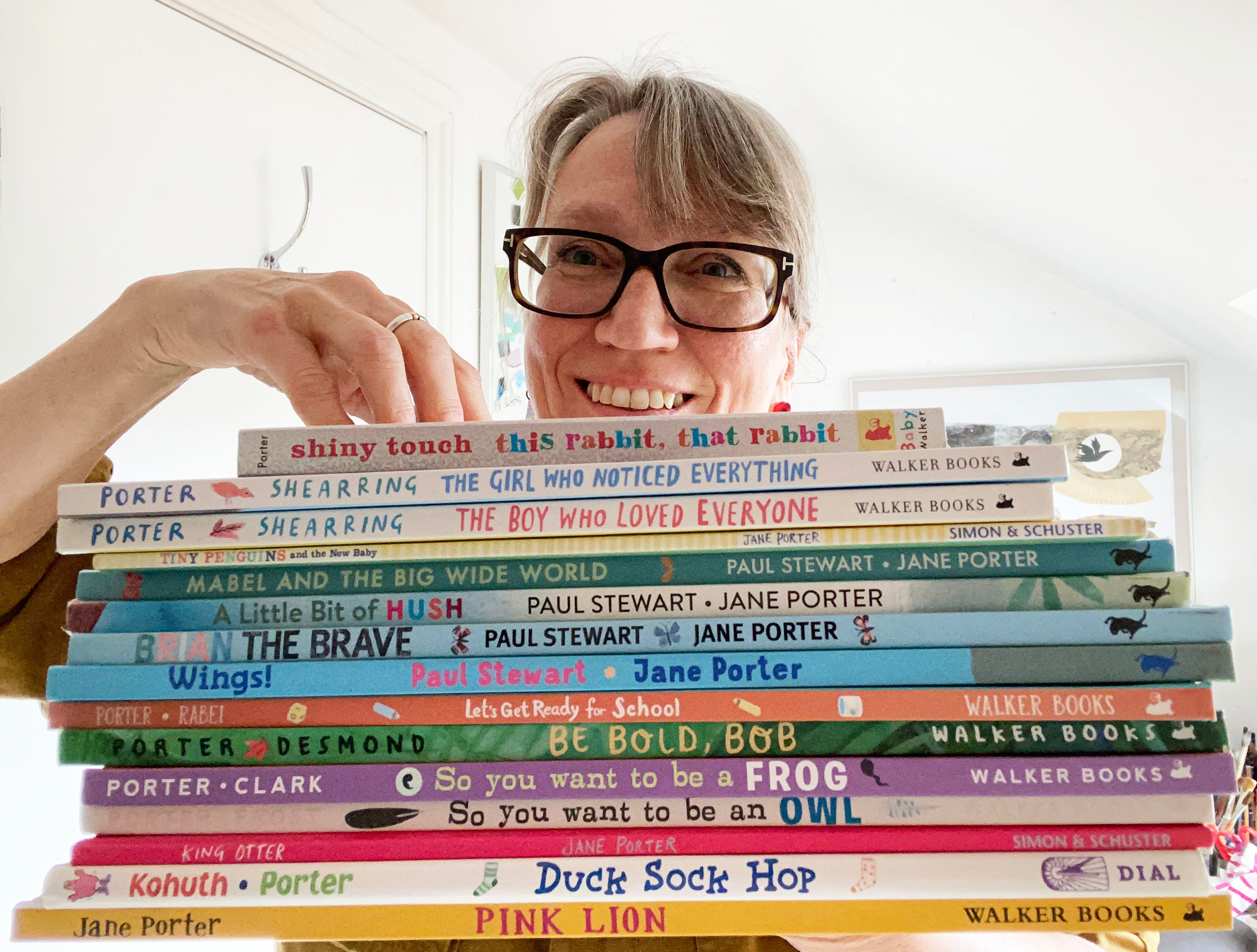
But it’s been a while since I had a contract.
The picture book industry is like a very long conveyor belt. You have to put things on that conveyor belt constantly if you want anything to come out at the very distant far end, especially as 90% of what you put on it falls off along the way.
When my Dad died in 2021, I stopped shovelling ideas onto that conveyor belt. And the result was a long hiatus, which fortunately was filled with the fun of my online comics class. Then my Mum died at the beginning of this year, and now I am wondering if there’s any point in getting back on the conveyor belt.
I’m genuinely thinking hard about this at the moment. I developed a new story with a lovely creatively-minded and generous-hearted agent who showed it to publishers a few months back. And they liked it - but only if someone other than me would illustrate it. Then there’s the ‘quiet’ problem.
I’ve had the ‘quiet’ conversation many times with picture book maker friends. In a world that’s getting faster and louder, stories deemed to be ‘quiet’ or ‘gentle’ are not what sells - or so publishers believe.
But I like writing quiet stories, they are the ones that are true to my inner self. And I KNOW there are plenty of quiet children out there who enjoy them. I don’t want to start writing ‘loud’ stories that don’t feel authentic.
Earlier this year I sprung awake early.
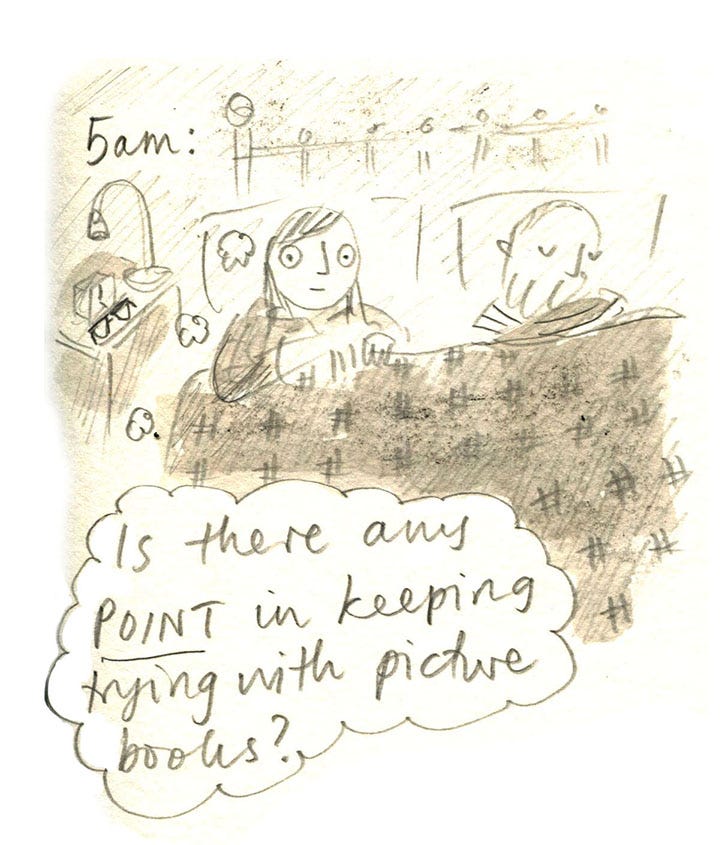
And I didn’t stop thinking about it all day…
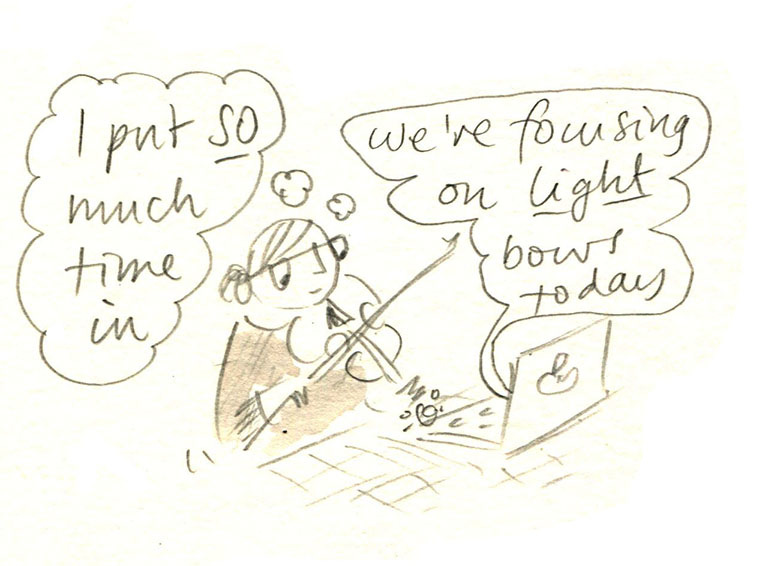
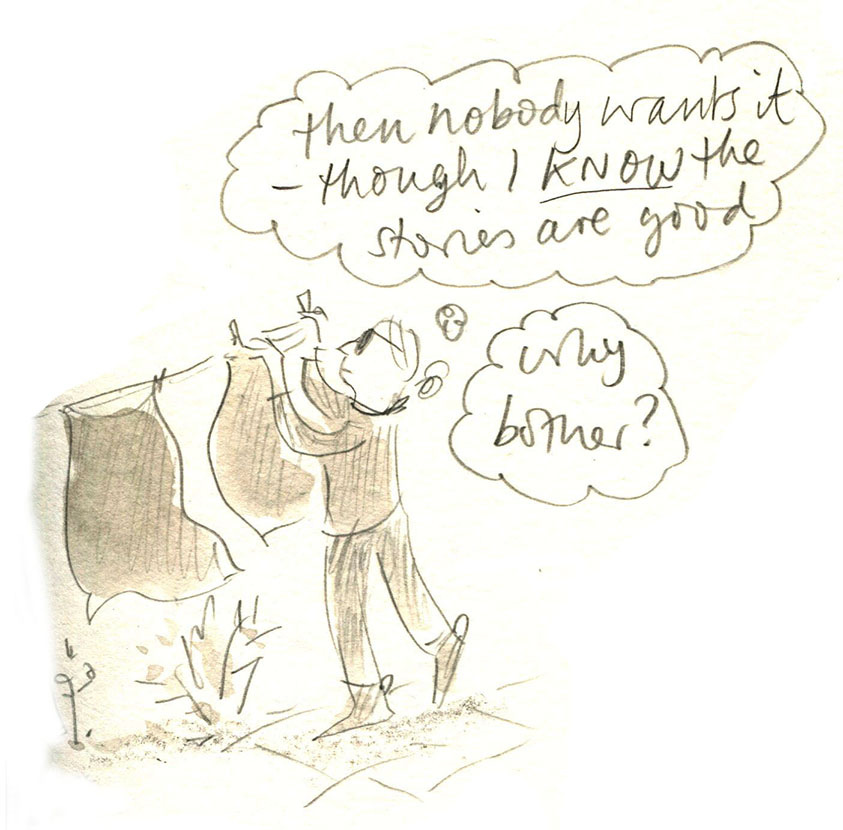
I went off to see a friend, feeling a bit like Fungus the Bogeyman when he cycles to work in a state of existential gloom (the Raymond Briggs classic was a book I loved aged 15, and that spread has stayed with me and pops into my mind whenever I cycle).
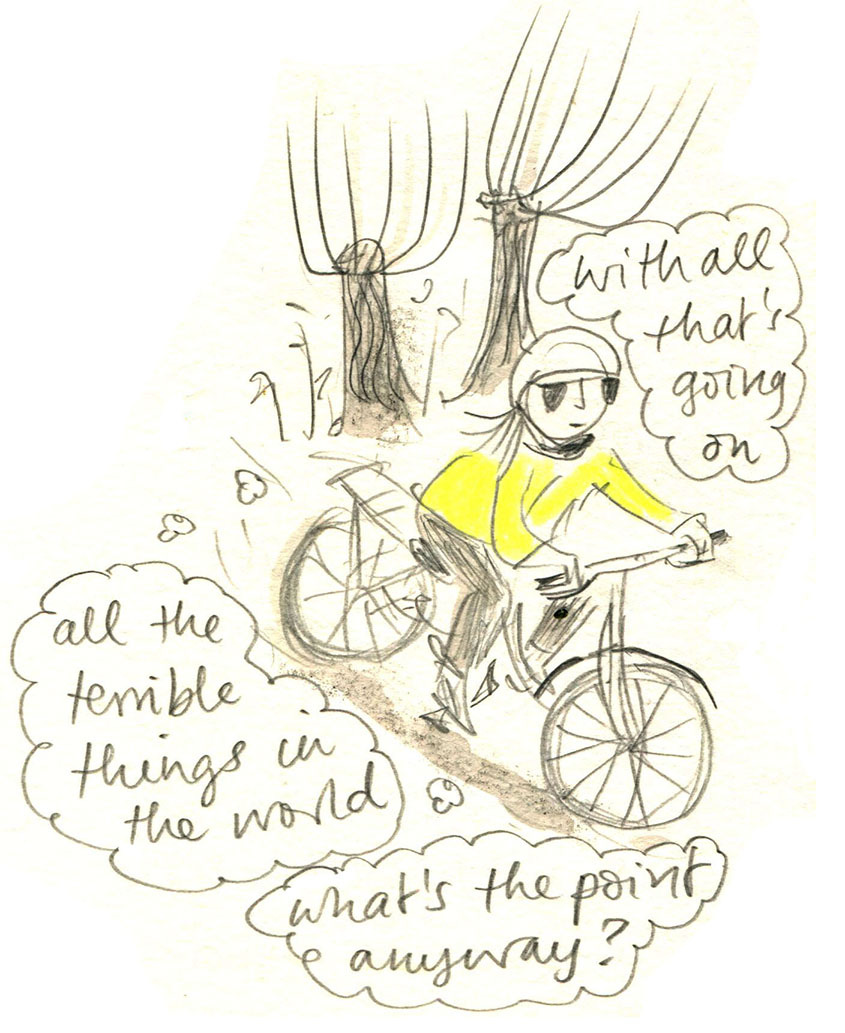
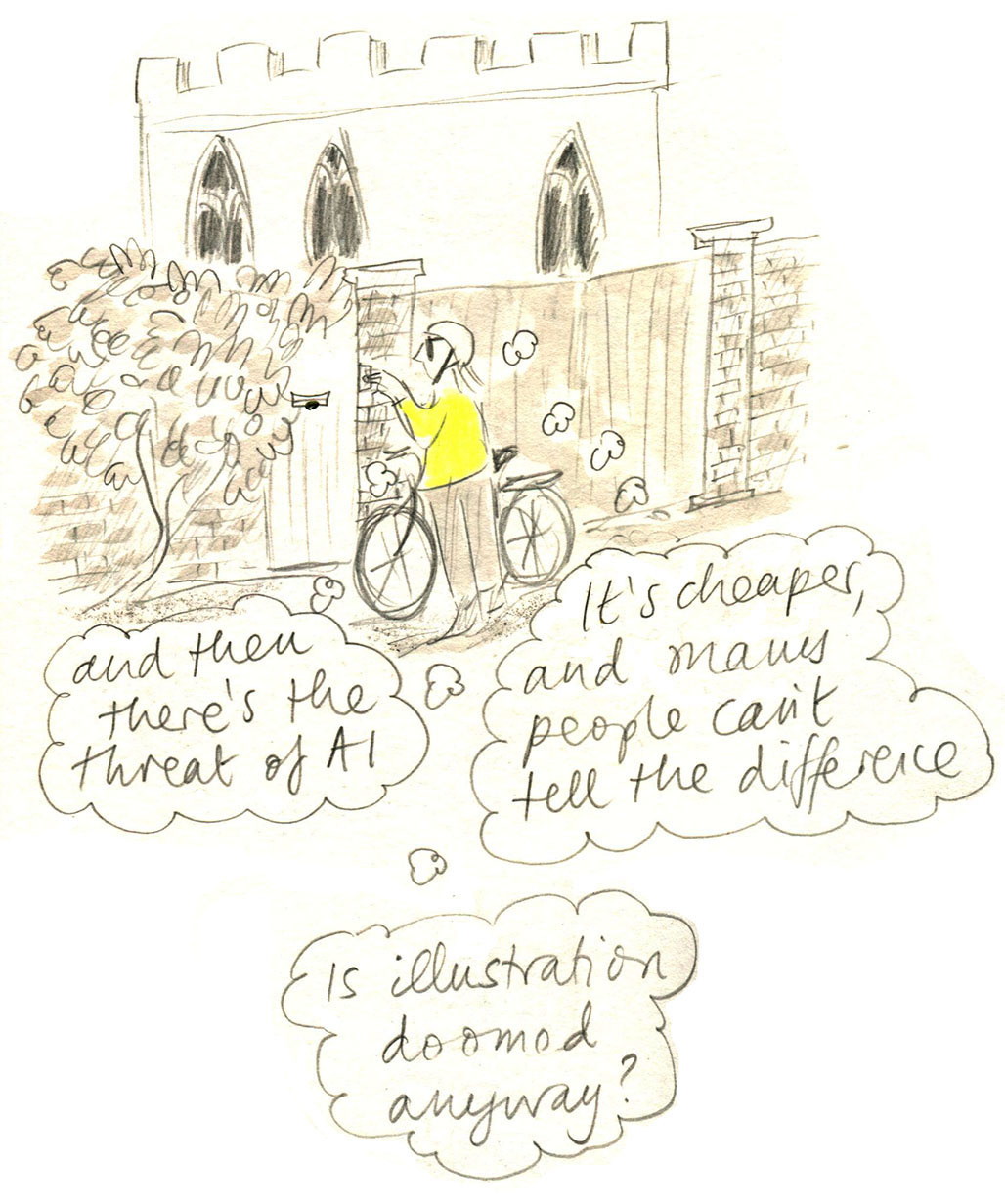
Do I really want to pour so much of my creative energy into something that’s unlikely to see the light of day? I’ve been lucky to have other work to keep me going - teaching, workshops, illustration work for some lovely clients like Historic Royal Palaces and the National Trust. But…
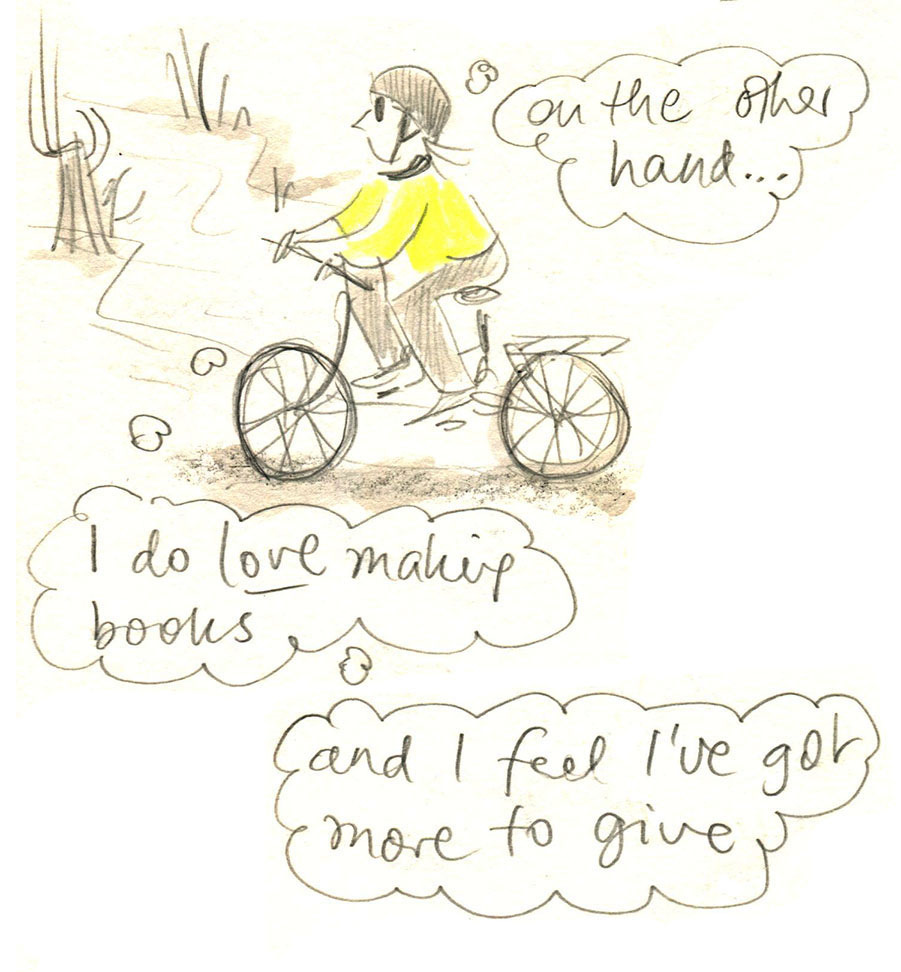
The value - and the price - of picture books
I’ve just been devouring ‘A British Childhood: How Our Children Live Now’ by Frank Cottrell-Boyce. It’s brilliant. He talks about how being repeatedly read a favourite picture book has immensely beneficial physiological effects on a young child’s brain development. So picture books are very, very important in the creation of happy, grounded humans. And yet…
A few weeks ago I was reading a story to my nursery group. I glanced at the back, and was startled to see that the cover price on this 20-year-old picture book was pretty much the same as it would be now. One the one hand, it’s good that in these inflationary, cost-of-living crisis times, something that’s so important to young children’s development remains accessibly priced. But on the other hand, it felt utterly crushing to realise how undervalued our work is when the price of literally EVERYTHING else has gone up significantly.
The whole industry depends on writers and illustrators spending months and months developing projects speculatively, initiating ideas that may never see the light of day. Return on investment: nil. How can this be possible for anyone without another income stream? And yet there are glorious stories to be told, and pictures to be made, by people who can’t afford to take this time to develop. Stories that will forever remain un-made.
Let’s talk about the money
If the cover price has remained depressingly static, the situation with advances is even worse. They seem to be shrinking - for most of us.
Sometimes people will say to me “So, how’s your latest book selling?” and I always say sheepishly, “I don’t know”.
The longer, more truthful answer would be, “There’s no way for me to find out unless I pester the publisher, and I don’t want to know anyway because the answer is unlikely to be ‘stratospherically’ and it will just be depressing.
And even if a book was selling moderately, I wouldn’t be making a penny: that only happens when sales are large enough to ‘earn out’ the advance - something which only a tiny percentage of picture books achieve.
I was cheered when I spotted Abie Longstaff (who does a great Publishing Peptalk newsletter) report that 92% of books published in the UK sell fewer than 1000 copies. It was sad to read, but consoling. Once, an editor in a major publisher told me that they see it like horse racing - they spread-bet on 10 picture book ‘horses’ knowing only one will jump all the sales hurdles. But that was several years ago, and they are now much more reluctant to gamble.
The curse of the co-editions
There are many things I had no idea about when I got into this business. But the one that feels the most like a guillotine above my head is the book fairs and the floods of co-editions that are meant to follow. A co-edition is what happens when your publisher makes a series of deals with other publishers around the world for your book to be translated into different languages and sold around the world. Very exciting when it happens, of course. But when it doesn’t? Your book is dead in the water before it’s even been published. It will sink like a stone to the bottom of the priority list.
The social media trap
Over the last ten years or more, social media has changed the landscape. On the upside, I know in the early days many illustrators were able to break through as a result of catching the eye of a publisher online. But on the downside, your numbers are scrutinised - big follower numbers suggest a ready audience, making a publisher feel you might be a good bet. Smaller numbers, not so much. And this is one of the reasons why celebrity authors have become such a big deal. There is an expectation that you, the creator, will bend over backwards to promote your book. It’s hard work and for most of us who are not celebrities, you do it alone. I’ve just had an interesting chat with Polly Noakes, who wrote about pausing Instagram today in her newsletter.
Polly was talking about the pressure to promote and to ‘stay relevant’, and how much has changed since she started in the industry in the late 80s. Back in those days, and even more so in the 1960s, publishers would take a chance on books they believed in without looking at the bottom line first. Legendary picture book editor Ursula Nordstrom’s collected letters ‘Dear Genius’ are utterly fascinating about how it all worked back then - they’re really worth a read.
Yet the very same industry that is still profiting from 60s classics like The Very Hungry Caterpillar and Where the Wild Things Are is no longer prepared to take a chance and create the conditions where books like that can emerge - everything has to be a proven commercial success before it even starts. Lists are shrinking and with them, diversity in every sense, and creativity, and bravery. Safe bets triumph over inventiveness and daring. Your sales track record is all.
Often we will do our very, time-consuming best to promote a book, yet it will still sink without trace. Read this article by Tasmina Perry at We Are All Creatives if you’d like some reassurance that it’s not your fault if your book doesn’t sell.
A loveliness of librarians
I know this really the collective noun for ladybirds, but librarians really are the BEST people. This is some of the team from Wandsworth Libraries who supported me when I did an event at Balham Library recently. They showed utter dedication and enthusiasm throughout - it was like a powerful shot of vitamins to this rather disheartened picture book maker. The event was for the GLL Literary Foundation, which I was delighted too be picked to be part of. I really felt so much better afterwards!
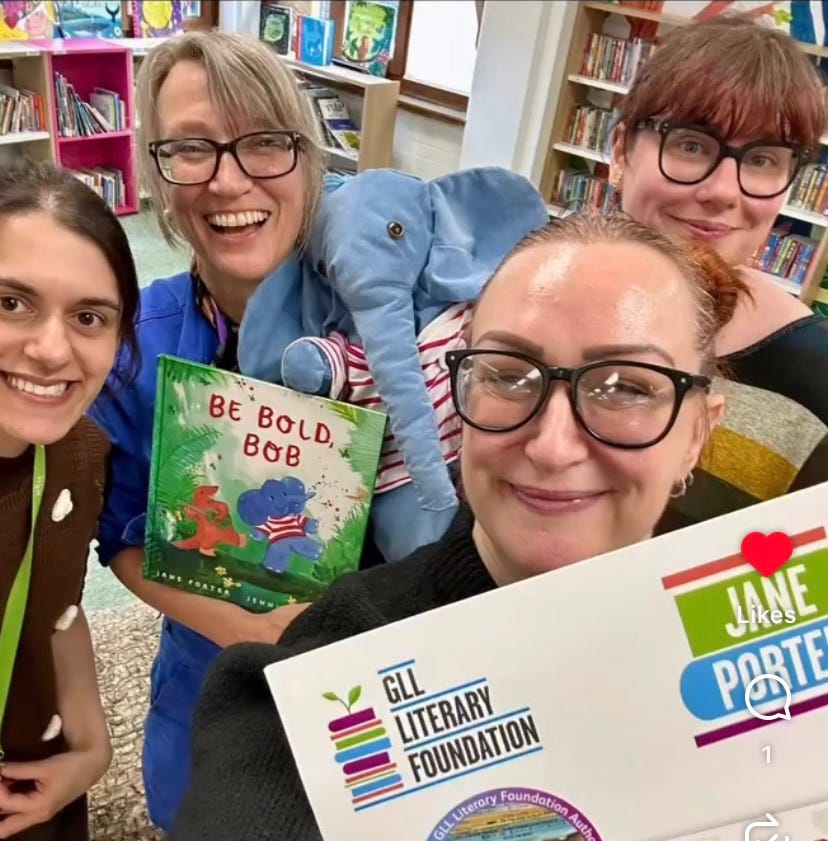
I’m a life-long library lover, but once upon a time I would timidly borrow only one or two books thinking I didn’t want to put the librarians to the trouble of re-shelving them. WRONG! Libraries need the borrowing figures to stay high - if anything can save them from cuts, it’s this.
Please use your local library, and borrow LOTS of books frequently. They are amazing places that deserve to be treasured.
Not many people outside the industry know about this, but Public Lending Rights (PLR) gives authors and illustrators a little sum of money every time your book is borrowed. This is a lifeline for many picture book makers when it comes into the bank account around February each year. So that’s all the more reason to use your library if you want to support authors and illustrators.
Unpublished but not unloved
Like all my fellow picture book makers, I have MOUNTAINS of unpublished, unwanted ideas - most of which I still look at and think, hey, that wasn’t too bad. What went wrong? Did I try hard enough? Were they too quiet? Did not enough editors see them? For now, I’m going to keep them in a drawer and think of them as exclusive secret stories rather than a terrible time sink. I’m going to retain my right to still feel proud of them.
Where does AI leave us?
I’m not a fan of AI when it comes to creative endeavours, though I’m sure it will be valuable for things like medical research. Here’s a reminder of the banner I made earlier in the year…
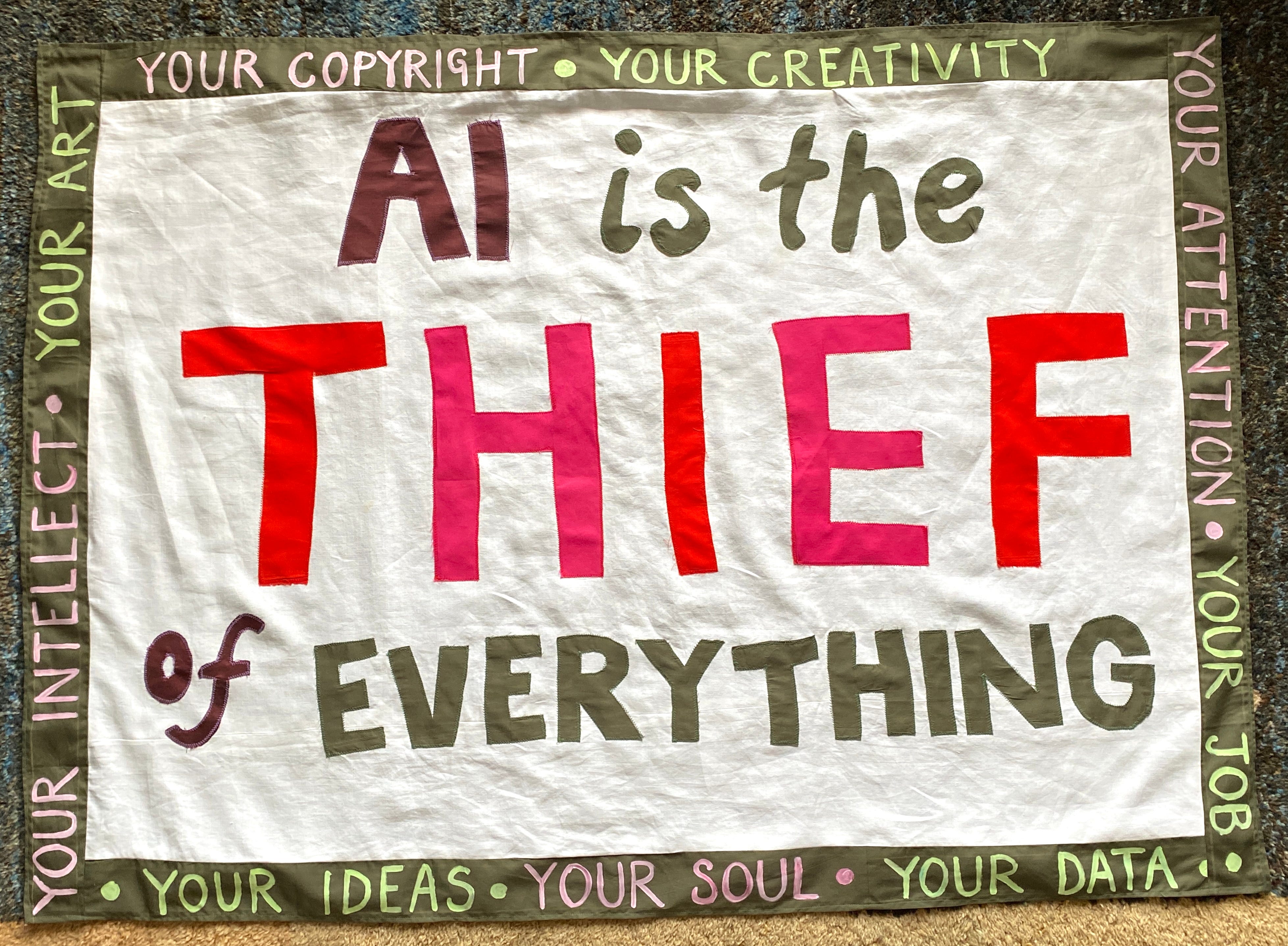
…and I have not changed my mind since. Will publishers turn to AI for both story and artwork generation? It will be a depressing day when they do, but given the commercial pressures I wouldn’t be at all surprised to see something that soulless in a bookshop one day soon. I can’t understand why anyone would want to use it for anything creative.
The whole point of being creative is enjoying the sometimes joyful, sometimes painful process of making something yourself with your heart and hands and mind. I do worry that human brains will simply atrophy in the future. Please don’t let that happen.
Does Finland have the answer?
I’ve been thinking about the whole problem of a commercially-driven picture book sector for many years, and have long held the dream that a government subsidy could transform everything. Then I found out this actually already happens in Finland! Finnish illustrator Maria Sann (you can find her on Instagram at maria.sann) wrote:
“In Finland most picture books are funded by artistic grants. Both the writer and the illustrator apply for funding for their work. These grants make sure the artists are working free from commercially driven outcomes and protect the artists from having to sell out their rights to make ends meet.”
Imagine that. A picture book world where you could be free to develop something that excited you - and will undoubtedly excite children - without the crushing thought that it might not sell enough copies or get enough co-editions to keep your career alive. And in the overall scheme of things, the government investment needed would be minuscule. Shall we make it happen? Given how beneficial books are to child development, surely it would be a worthwhile investment? Arts Council DYCP grants are helpful if you can get one, but something specifically for picture books, with a guarantee of publication at the end, would be a dream.
So what can we do, both as creators, and as people who enjoy picture books? I don’t have the answers, but I’m going to keep making for the joy of it, keep borrowing from libraries and continue supporting independent bookshops by buying in person. What will you do?
I hope this hasn’t been too depressing. Do let me know what you think!
Yes, yes, yes to all these. I'm definitely not a fan of what the UK publishing has become and where they are heading at the moment. The problem is publishers have began to operate as corporates focusing on productivity and profitability (no wonder some started using AI) rather than as cultural institutions. I'm not saying people who work in publishing don't care about books (individuals whom I personally worked with have been wonderful) but they are unfortunately cogs in the big capitalist machine.
One of my books that has been unsuccessful in term of sales (no co-edition so far) has recently shortlisted for a children-led award. Children chose the shortlist from 70 books. So I definitely think there's a big gap between what adults think children want to read and what children actually want to read. So you're right to say there must be children who enjoy reading quiet books.
Maybe, like water and transport, we need to nationalise publishing? Jokes aside, publishing definitely needs some sort of grands or incentives.
Oh Jane, so much of this rings true, I've long felt that the cards are forever stacking against us authors and illustrators on the part of publishers, and for promoting yourself, if like many you're disillusioned with social media and uncomfortable doing public events, it's a very tough call indeed.
I have no solutions, other than to don the blinkers and keep working on ideas, keep submitting, keep hoping. Your state of mind is the most important thing, finding fresh inspiration so hard in these barren and bland publishing times, the support of those around essential I think.
You've written what so many of us are thinking, thank you Jane!